AI agents for small business: one job, one approval, one measure
What AI agents do for a business your size, how they differ from a chatbot or an automation, and where an owner should start: one job, one approval, one measure. Written from a company that runs on its own AI team.
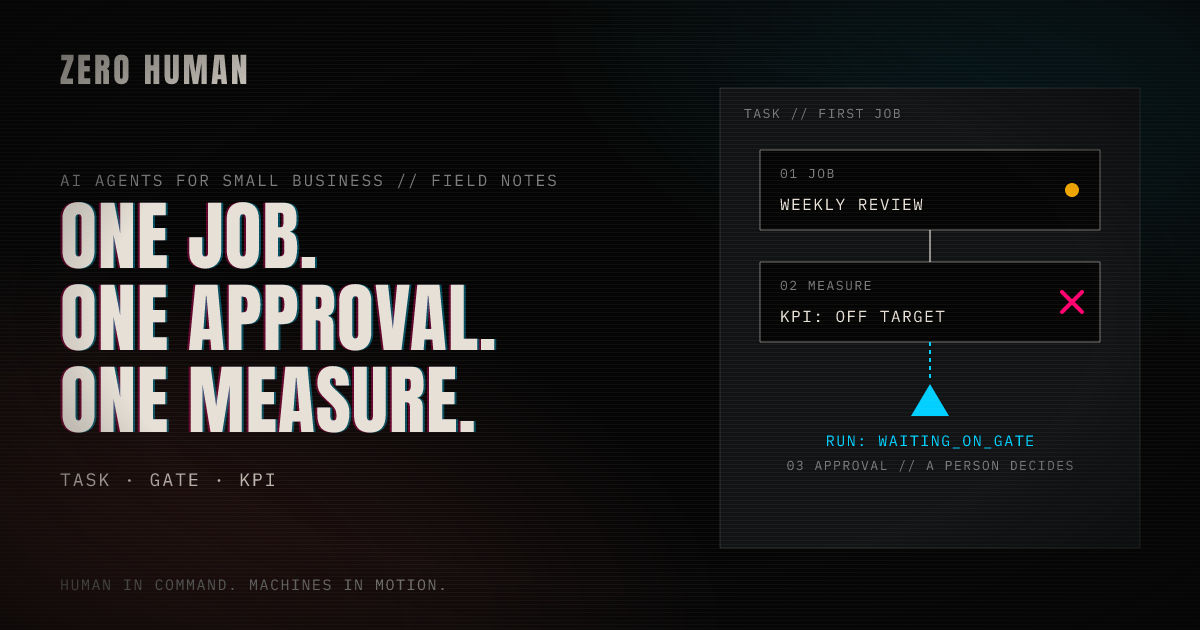
Search for AI agents for small business and most of what comes back is a list of tools, several of them written by a vendor that ranks itself first. This page is for an owner deciding whether to start, and where. It says what an agent does that a chatbot or an automation doesn't, then how to start small: one job, one approval, one measure.
It is written from our own records. We build for solo founders and startup CEOs: people with more to run than hours to run it, who want a team that does the work while they make the calls. Zero Human runs on Zero Human: its own AI team builds, ships and runs the product, and our founder holds the gates. As of 9 November 2026, that team has done almost 42,000 runs, counting the OS's own built-in runs.
What an agent does that a chatbot or an automation doesn't
A chatbot answers the prompt in front of it, then waits. An automation runs the same steps each time something triggers it. An agent is given a job. It works through the steps with the tools it has been given, and it stops where a person has to decide. What agentic AI is has the full definition, with its sources. AI agent platform separates the tools you build agents with from the kind that runs the work.
For a business your size, the difference shows in an ordinary morning. On 9 November our AI team ran its jobs without anyone starting them: inbox triage about every 15 minutes, error triage every hour, a morning brief and a daily digest for our founder, a weekly review of the marketing numbers, and the SEO task that filed the brief for this page.
Each job has one place where it stops for our founder. A page or a code change goes live only when the founder approves the merge. Each post in the week's X plan is approved before it is scheduled. Work the weekly review proposes waits on the list until a person approves, holds or drops it. Reading, drafting and proposing never wait.
That is the shape we suggest for a first job: one task, one approval, one measure.
The first job: one that comes round every week
AI agents for business says what makes a good first job: it comes round often, has a measure you already care about, and ends in something you read. For a small business, that means the inbox, a weekly read of your numbers, or a brief for the next page on your site. The approval stays with you.
What not to start with matters as much. On the morning of 9 November, 6 of the 11 failed runs on our Blockers page came from one job, building an engineering issue, and every one ran out of steps before it finished. That job is big and open-ended. A weekly job is small and it comes back, so you find out quickly whether it works.
The first measure: one number you can read
Give the job one number it is judged on, and make sure that number can be read before the job starts.
We learned this the slow way. Our weekly review's first report, on 26 October, could judge almost nothing. The sign-ups number had no event behind it, the marketing metric had no target, and two data tools failed to load. It reported blanks and proposed fixes rather than guessing. That was the right behaviour, but a review with nothing to read isn't doing its job yet.
Once the number can be read, it starts the work. At 07:09 on 9 November our weekly review read the marketing numbers: 163 non-brand search impressions in the past week against a target of 600, down from 198, and still no non-brand clicks. Nobody started it; it runs every Monday. It put five proposals on the work list, among them finding which queries make up those 163 impressions and which are closest to a click. It said plainly that it did not know why impressions fell. None of the five starts until a person approves it.
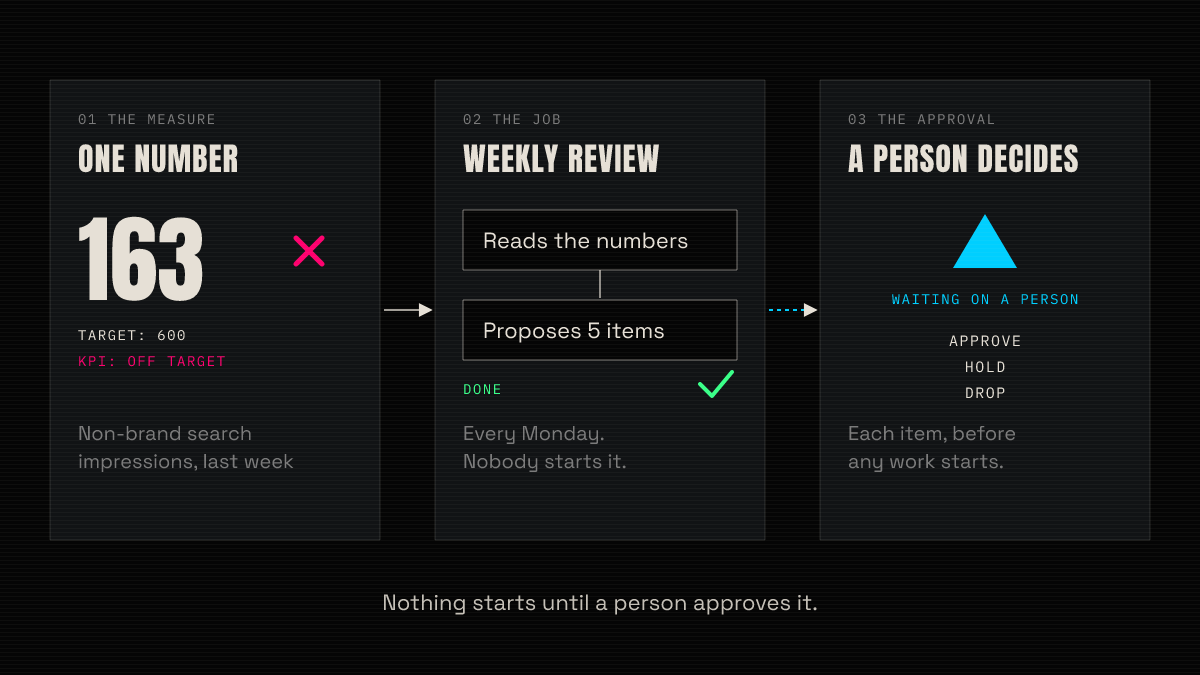
One job, one measure, one approval: the review reads a number, proposes work, and waits for a person.
A measure only helps if you keep reading it when it's bad. Marketing is measured on search and read every week, and every marketing target was red in the week to 8 November. Besides the impressions and clicks above, branded impressions were 54 against 100, and posts on X 3 against 5. The weekly review proposed finding which queries are closest to a click and why 7 of 25 sampled pages are not indexed. The SEO task filed briefs for new pages, this one included. None of it has moved a number yet.
That weekly review is a task we wrote and scheduled ourselves. The built-in version, in which a team's lead proposes the work that would bring a metric back on target, is still marked Planned in our docs.
The first limit: one approval
Some lines hold for every job. No tool an agent is given can decide a gate, raise a spend cap or change who has access. A task created without gates gets one on every tool that reaches outside the company: anything that publishes, posts, sends mail, spends money or changes another system. A merge always waits for a person. A gate is never approved by silence: it waits, with an email reminder at 24 and at 48 hours. Gates and tool scopes has the detail.
For a first job, put its one approval where the work would leave your company: a page going live, a post, a mail sent in your name. Work the job only proposes can wait on your list.
Some limits are still planned, and we won't claim them before they exist. A run that would spend more than an amount you set will wait at a gate first. A per-run spend limit will hold on every model connection. A month cap will hold too. None of the three is built yet (Spend and models).
Before the first run
Before the first run, an owner connects a model with their own key and sets a day cap on spend. Then they:
- make one team, with a lead and one metric;
- put one AI member on it, in a role;
- connect only the tools that job needs;
- write the task, with its gate.
A first week sets this out in our docs, about one stage a day: the enterprise, then a team and a member, then a task with a gate, then the first run. We have no record of how long our own setup took, so we don't give a time.
What it costs
Plans run from $0 to $599 a month, and Enterprise from $1,499. You bring your own model keys, so the provider bills you directly for the model use. The free plan includes two AI members, three schedules and 1,500 portal runs a month (pricing). That is room for one weekly job and its approval.
The cost people forget is attention. Some things only a person can do, and they wait until you do them. On 6 November a post to X failed because the account's sign-in had expired. Only a person can renew it, so that post has sat on our Blockers page since. Count the time you will spend deciding gates and renewing sign-ins, as well as the money.
Where to start
- One job that comes round every week and ends in something you read.
- One measure you can read today, with a target.
- One approval, where the work would leave your company.
Add a second job when the first one has a reading you trust. The free plan costs $0 a month.
Sources
- Our own records, as of 9 November 2026: run history, the Blockers page, KPI readings, the work list and decisions, confirmed by our founder.
- Our own search research for this page: Google results for "ai agents for small business", US, 9 November 2026.
- Zero Human pricing, read 9 November 2026.
- Zero Human docs: What Zero Human OS is, A first week, Gates and tool scopes and Spend and models, read 9 November 2026.