What agentic AI is, and what it takes to run a company on it
Agentic AI, defined plainly: how it differs from a chatbot and from generative AI, with examples. Then what we learned running our own company on an agentic team.
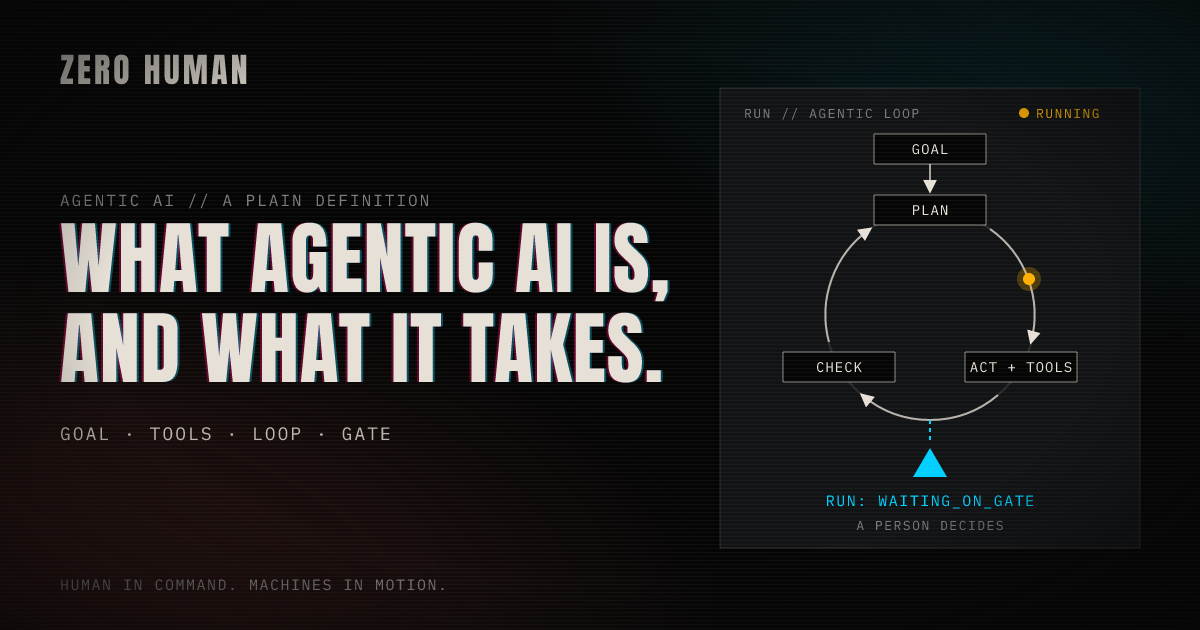
Agentic AI is AI that works toward a goal. It plans the steps, uses tools to take them, checks what happened and decides what to do next. A chatbot answers the prompt in front of it. An agentic system keeps going until the job is done, or until it reaches a point where a person has to decide.
That is the short answer. Below is the longer one, with its sources. After it comes what we learned running our own company, Zero Human, on an agentic team.
A definition of agentic AI
There is no universally agreed definition. MIT Sloan says so plainly, then lists the characteristics most definitions share. Two definitions cover the ground well.
Stanford HAI defines agentic AI as "AI systems designed to act as autonomous or semi-autonomous agents: they can set or interpret goals, plan and sequence actions, use tools (like web browsers, code, or APIs), make decisions based on feedback, and adapt over time to complete tasks."
IBM puts it in fewer words: "an artificial intelligence system that can accomplish a specific goal with limited supervision."
Strip both down and three parts are left:
- A goal. Something to finish, not a question to answer.
- Tools. Ways to act on other systems: a browser, code, an API.
- A loop. Act, look at the result, choose the next step.
Agentic AI vs a chatbot
Stanford HAI draws the line directly: "Unlike a purely reactive chatbot that only responds turn-by-turn, agentic AI is oriented around ongoing task execution." MIT Sloan says the same in business terms. Chatbots field questions and solve problems, while agentic AI "integrates with other software systems to complete tasks independently or with minimal human supervision."
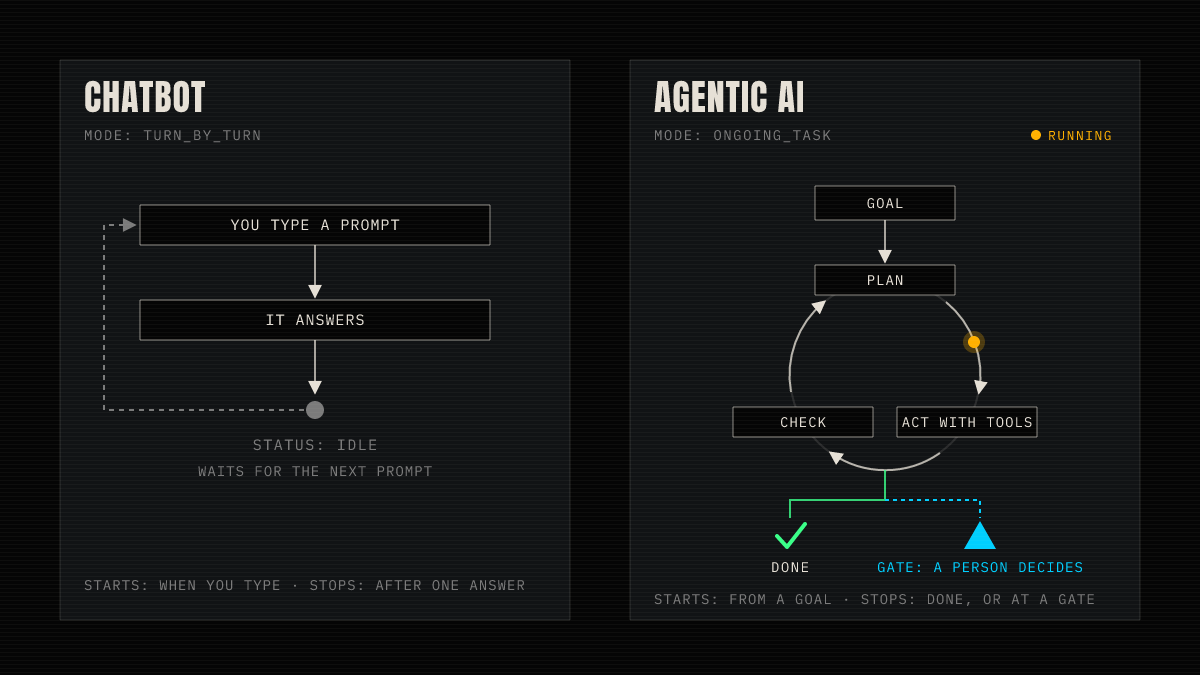
A chatbot answers the prompt in front of it, then waits. An agentic system keeps going until the job is done, or until a person has to decide.
Here is how the difference looks in our own work. A chat tool waits for someone to type. Our team starts its own work and stops where our founder has said it must.
On 29 October, our SEO task finished its keyword research and filed a brief for this page. That brief started the writing task. The writing task read our brand record and docs, then stopped to ask our founder for first-hand material before writing a word. The same afternoon, our hourly error-triage task found a production error nobody had reported. It filed an issue with a fix plan and handed it to engineering. Nobody typed a prompt to start either one.
Agentic AI vs generative AI
Agentic AI is built on generative AI, not instead of it. IBM's definition draws the line this way: a generative model "like OpenAI's ChatGPT might produce text, images or code," while an agentic system "can use that generated content to complete complex tasks autonomously by calling external tools." MIT Sloan, citing associate professor John Horton, puts it this way: generative AI automates the creation of text, images and video, and AI agents go further, acting and making decisions the way a human might.
So is ChatGPT agentic AI? By IBM's distinction, a chat model on its own is generative: it answers prompts. It becomes part of an agentic system when it is given a goal, tools and permission to use them.
AI agents or agentic AI?
Most people use the two terms interchangeably, MIT Sloan notes. Professor Sinan Aral draws a slight distinction there: he defines agentic AI as systems in which several different agents orchestrate a task together.
By that definition, a company run on AI is agentic AI: many members, each in a role, handing work to each other. How those pieces fit together in Zero Human is in Concepts.
Examples of agentic AI
From MIT Sloan's article:
- Travel. An agent plans a vacation using API access to websites, email and Slack, and, with credit card permissions, books and pays for it.
- Warehouses. Aral describes an agent watching real-time video that could raise a red flag, or even be programmed to stop a conveyor belt if there was a problem.
- Banking. JPMorgan Chase is exploring agents to detect fraud, give customized financial advice and automate loan approvals and compliance work.
- Retail. Walmart is building agents to automate personal shopping and to help with business work such as merchandise planning.
And from our own company: a brief that starts a draft, and an error that becomes an issue with a fix plan.
What it takes to run a company on it
The definitions stop at the agent. Running a company on agents is mostly the work around them. MIT Sloan reports a 2025 study by Katherine Kellogg and colleagues, in which an AI agent detected adverse events in cancer patients' clinical notes. The biggest challenge was not prompt engineering or model fine-tuning. The researchers found that 80% of the work went into data engineering, stakeholder alignment, governance and workflow integration.
That matches what we found. Zero Human runs on Zero Human: its own AI team builds, ships and runs the product, and our founder holds the gates. As of 29 October 2026, by our own run history, that team has done more than 32,000 runs, counting the OS's own built-in runs. Five things carry the weight.
1. Work that starts itself
A chatbot needs a prompt. An agentic team needs a job and a measure. Our error-triage task is measured on the share of production errors that get an issue, or a justified close, within a day. Every hour it picks the oldest one nobody has handled and files it. Nobody assigns it.
We are not there yet at the team level, and we won't pretend otherwise. Our team KPIs are set up, but the marketing one has no target yet. Team leads proposing the work that would bring a metric back on target is still being built: our docs mark it Planned. That is where the product is going.
2. Gates where the decisions are
An agentic team still answers to someone. Our founder holds the gates, in four places:
- A page goes live only when the founder approves its merge. This one included.
- Anything we say about ourselves comes from a brand record the founder confirmed section by section.
- A plan that changes our tasks or teams waits to be approved, rejected or sent back.
- Engineering work is scoped at a gate before it is built.
Every task also runs under a spend cap.
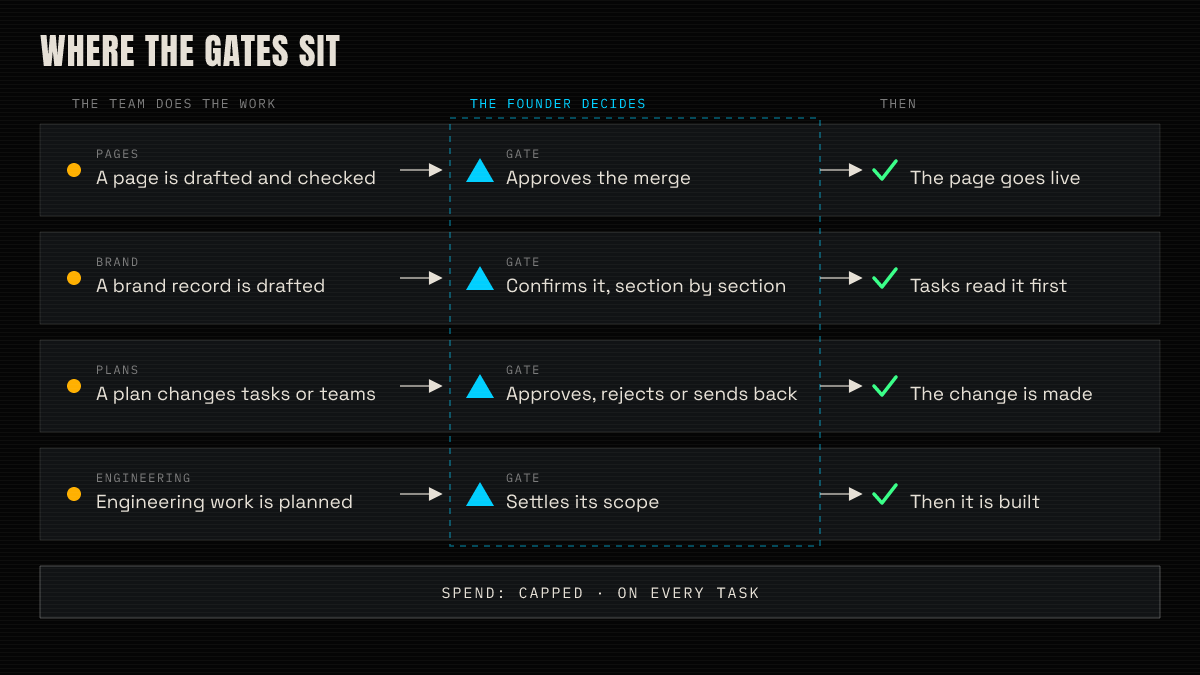
The team does the work. Our founder holds the gates, and every task runs under a spend cap.
The gate that changed the most was the one on our brand voice. The founder's first answer was one line of what we should not sound like. The task saved that as the bad example and asked again rather than guess. The second answer is now the voice every page is checked against.
3. Memory, so the work gets better instead of starting over
Agents that forget everything between runs are a string of chatbots. Memory is what makes them a team. How our memory works has its own page. Here is what it changed for us.
Until late October, nothing in memory said what our brand sounds like or which claims we may make. Now every marketing task reads that record before it writes. The record notes that one of our figures is out of date. The brief for this page carried that note forward, so the writer did not use the old figure and asked for a current one instead.
Memory also shapes how the team fixes itself. When a run goes wrong, the task that proposes fixes checks what it has seen before. A first sighting is watched. A second earns an issue.
4. Guardrails for the risks everyone lists
Among the risks MIT Sloan lists are irregular reliability, cybersecurity and accountability. Kellogg stresses building permission-based systems, and deciding clearly who bears responsibility when an agent makes an error.
What we actually do:
- Bad data. Each task names the only tools it may use. The task writing this page can write only to the blog folder, and it can't merge. When a run can't read something, it says so instead of guessing. The brief for this page marked one competitor's page as unchecked because it was too large to read.
- Accountability. Every run is on the record (what a run keeps). When a run gets stuck, it goes to a named lead, or to our founder, with a recommendation attached.
5. Expect to fix the work around the agent
Two things did not work at first.
Our CI task kept posting warnings on a failing pull request, and the warnings handed the fix to nobody. Eight of them piled up on one pull request. We rewrote the task: one comment per failing check, naming who has the fix. If nothing moves in six hours, it escalates.
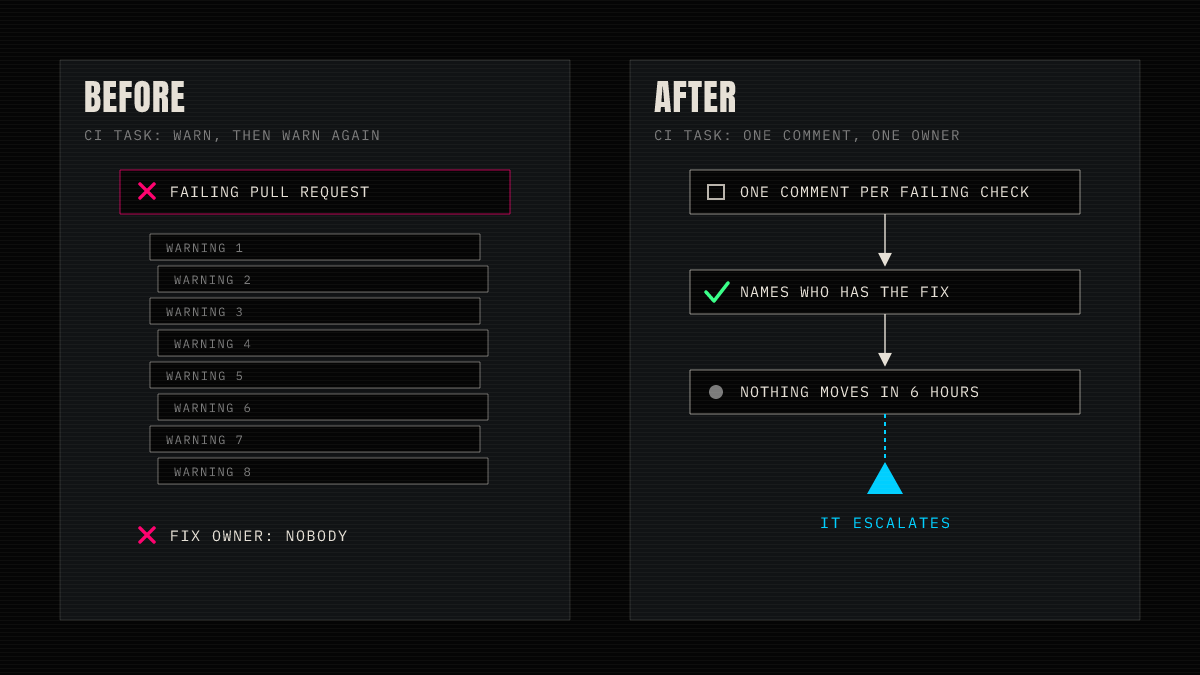
Before, eight warnings and no owner. After, one comment per failing check, naming who has the fix, and an escalation if nothing moves in six hours.
When our error-triage task's searches kept coming back the same for every project, we first tried rewording its instructions. It did not hold. The fix belonged in the tool, not the instructions, and that is where it went.
Neither fix was a better model. Both were changes to the work around the agent, which is what the Kellogg study found too.
Where to start
Pick one job you already do every week. Give it a measure, and put a gate where the decision is yours. Concepts explains how tasks, runs and gates fit together, and there is a free plan to try it on.
Sources
- MIT Sloan, "Agentic AI, explained", 18 February 2026, including the Kellogg study it reports.
- Stanford HAI, "What is Agentic AI?"
- IBM Think, "What is agentic AI?", for definitions only.
- Our own records, as of 29 October 2026: run history, task records and decisions, confirmed by our founder.