AI agent platform: what one is, and how a business owner should choose
What an AI agent platform is, the kinds on offer, and how a business owner should choose between them. Written from a company that runs on its own AI team.
Search for "AI agent platform" and most of what comes back is written for someone who wants to build an agent. The lists compare frameworks by licence, stars and price. This page is for a business owner who wants work done. It says what a platform is, the kinds on offer, and how to choose between them.
It is written from our own records. Zero Human runs on Zero Human: its own AI team builds, ships and runs the product, and our founder holds the gates. As of 6 November 2026, that team has done more than 40,000 runs, counting the OS's own built-in runs.
What an AI agent platform is
An agent is AI given a goal and tools. It works in a loop until the job is done, or until a person has to decide. What agentic AI is has the full definition, with its sources.
A platform is the software the agents run on. Patronus AI's engineering guide puts it this way: platforms "manage workflows that go beyond a single LLM prompt. They help coordinate tasks, maintain context, and connect with external tools or APIs."
So the model does the thinking. The platform decides what the agent remembers, which tools it may touch, and what happens between one step and the next.
The kinds on offer
The same guide sorts platforms into four kinds, by how much code they take:
- No-code tools, such as n8n and Make. You build a flow from blocks. They are quick to set up and good at joining apps together.
- Low-code visual builders, such as LangFlow. A visual layer over a code library, good for prototypes and internal demos.
- Code-first frameworks, such as LangGraph, CrewAI and AutoGen. Full control over memory, steps and tools, for teams with engineers to run them.
- In-house stacks. Your own code around a model's API. The most control, and the most to build.
All four answer one question: how do I build an agent? Each assumes someone on your side designs the flow, connects the tools and keeps it running. The guide says as much in its advice on team fit: "Consider who will be responsible for maintaining the system on a day-to-day basis."
There is another kind, and it answers a different question: who does the work, and who decides? A platform of this kind runs the work itself. You describe the company: its teams, the jobs each one does, the targets, and the decisions that wait for you. The agents do the work as a team, and every run is on the record.
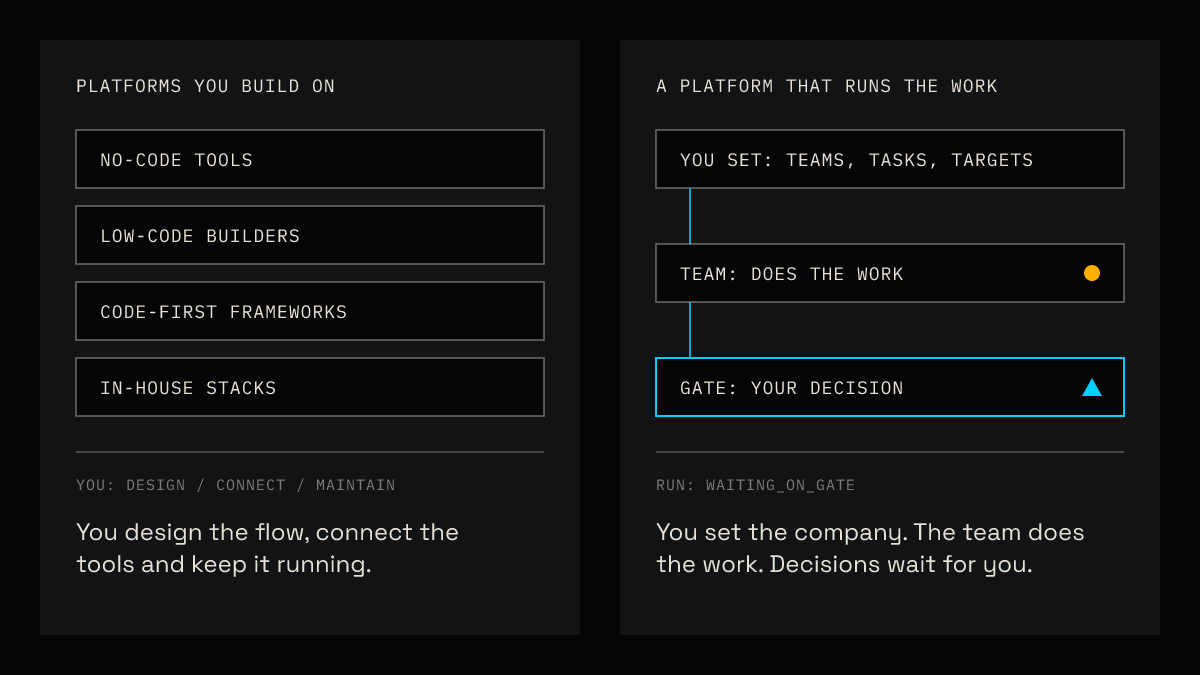
Most platforms are something you build agents on. A platform that runs the work asks you for the company instead: its teams, its targets and its decisions.
That second kind is the one we build and run on. Zero Human is not a builder or a code library. It is an operating system that runs a company's work with AI team members: you set the teams, roles and tasks, they do the work, and the decisions that matter wait for you.
What it looks like when a platform runs the work
Here is what that difference looks like in our own records this week.
The work starts itself
At 09:15 on 6 November, five jobs were queued without anyone starting them: inbox triage, opening a draft pull request, reviewing a pull request's experience, checking it is complete, and reviewing a run that failed. The ones an owner would recognise as paid work today are the inbox and the reporting. The rest is engineering.
Which job to give an agent first is its own question. AI agents for business answers it.
A target, and a light that says how it is going
Marketing's target is at least 600 non-brand search impressions a week. The reading on 2 November was 198, so the light is red. In the four days after it, the SEO task filed three briefs for new pages, and our founder dropped one of them. This page came from the third.
Proposing work from a red light on its own is still planned. Our docs mark it that way.
Memory that changes the next run
On 4 November our SEO task filed a brief for a page we had published two days earlier. Our founder dropped it. The next day the same task stopped without filing, because memory held that decision and it would not risk a third copy. The brief for this page lists the live page and the dropped brief under "Do not repeat".
Lines the agents cannot cross
Agents read, triage, draft, file issues and briefs, and open pull requests without asking. A page going live, anything said about the brand, a change to tasks or teams, and engineering scope wait for our founder. No tool the platform gives an agent can decide a gate, raise a spend cap or change who has access.
Checks that hold the founder to the record too
The first check of our "AI agents for business" page failed. A line our founder had approved said the per-run spend limit is the one figure the OS holds a run to. Our own docs said it is only partly enforced. The writing task took the clause out and said so, and the page went live without it.
What setup and cost look like
Setup is writing the company down: its teams, the members on them, their roles and the tasks each one does. Then you connect the tools those tasks need, with your own model keys. Our team works through our code host for issues and pull requests, DataForSEO and Google Search Console for search, Sentry for errors, Postmark for mail and Metabase for data. The agents never see the credentials.
Plans run from $0 to $599 a month, and Enterprise from $1,499 (pricing). You bring your own model keys, so the provider bills you directly. Every task declares the most one run may spend: the task writing this page, up to $2. Spend and models says how far that limit is enforced today.
How to choose
Start from what you want done, not from a feature table.
- One flow, and someone on your team will build it. A no-code tool is the quickest start.
- Engineers who want full control of how an agent thinks and acts. A code-first framework, and your team runs it.
- Work done across the company, with the decisions kept yours. A platform that runs the work.
Whichever kind you look at, ask about the record. The Patronus guide calls capturing "every input, output, and decision point" its most important recommendation to customers. Without it, diagnosing errors "becomes a matter of guesswork."
The five questions in our earlier post cover approvals, spend, memory, the record and what happens when an agent cannot do something. Two more matter when you are choosing between kinds:
- Who keeps it running? A builder or a framework needs someone on your side to design each flow, connect each tool and fix it when it breaks. Count that person's time in the price.
- What is it measured against? A flow runs when something triggers it. A team should have a target, and a reading you can see, so you know whether the work is helping.
Where to start
Pick one job that comes round every week, and decide where it should stop for you. Concepts shows how teams, tasks, runs and gates fit together, and the free plan costs $0 a month.
Sources
- Patronus AI, "AI Agent Platforms: Tutorial & Comparison", read 6 November 2026, for the definition, the four kinds and the quoted advice.
- Our own search research for this page: Google results for "ai agent platform", US, read 6 November 2026.
- Our own records, as of 6 November 2026: run history, task records, KPI readings and decisions, confirmed by our founder.
- Zero Human pricing, read 6 November 2026.
- Zero Human docs, What Zero Human OS is and Spend and models, read 6 November 2026.