AI agent guardrails: which limits hold when an agent acts, and what a small company sets first
What AI agent guardrails are for an agent that acts, not one that only talks: the four places a limit can hold, which of ours are enforced and which are only instructions, and what a small company should set first.
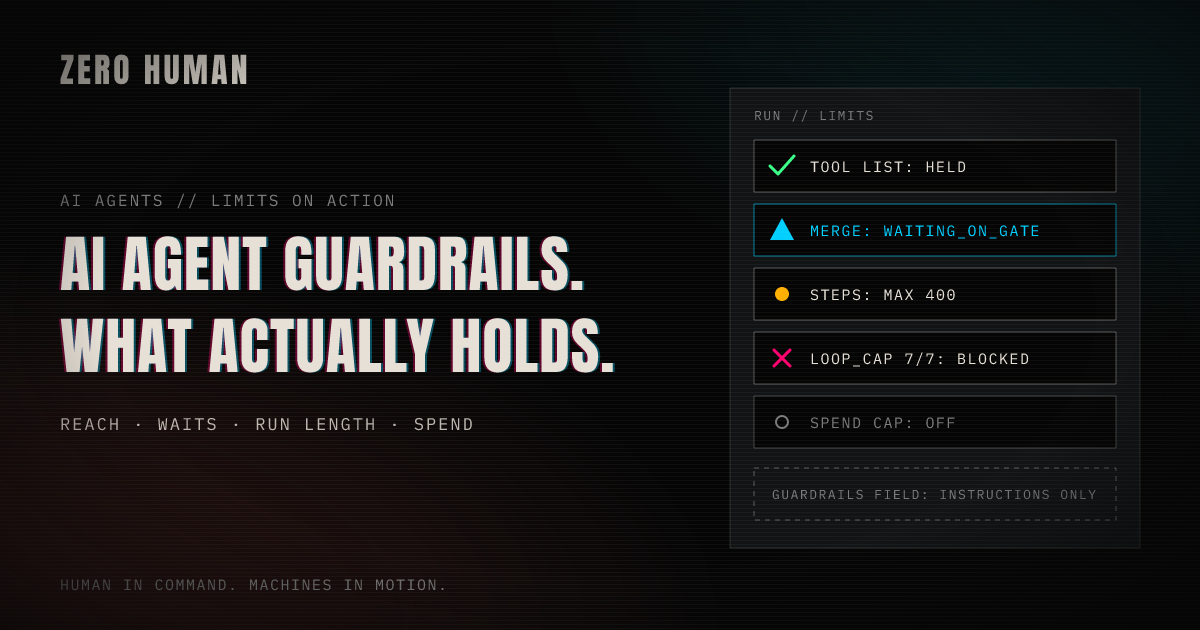
Search for AI agent guardrails and most of what ranks is written by security vendors for enterprise security teams, and much of it ends in a product. This page is for a business owner about to give an AI agent real access: to send, publish, spend or change data. It covers what guardrails mean for an agent that acts, not one that only talks, the four places a limit can hold, which of ours are enforced and which are only instructions, and what a small company should set first.
It is written from our own setup. Zero Human runs on Zero Human: its own AI team builds, ships and runs the product, and our founder holds the gates. As of 25 November 2026, our own AI team has done more than 56,000 runs, counting the OS's own built-in runs. What an agent is, and how it differs from a chatbot, is in What agentic AI is.
What AI agent guardrails are
IBM's explainer gives the common definition. AI guardrails are "the safeguards that keep artificial intelligence (AI) systems operating safely, responsibly and within defined boundaries." They cover "policies, technical controls and monitoring mechanisms", across data, models, applications and infrastructure. IBM's picture is a road: guardrails are "like the barriers along a highway: they don't slow the car down, but they do help keep it from veering off course."
Most of that is about what a model says. An agent also does things. The OWASP Top 10 for LLM Applications names the risk that comes with doing. It calls it Excessive Agency: "the vulnerability that enables damaging actions to be performed in response to unexpected, ambiguous or manipulated outputs from an LLM, regardless of what is causing the LLM to malfunction." It traces the cause to three things: "excessive functionality; excessive permissions; excessive autonomy."
The words that matter are "regardless of what is causing the LLM to malfunction." You can't make an agent that is never wrong. You can limit what a wrong step can do. So for an agent that acts, a guardrail is a limit on what it can do, held by something other than the agent, at the moment it acts.
A written rule is not a guardrail
OWASP's advice is to "implement authorization in downstream systems rather than relying on an LLM to decide if an action is allowed or not." LangChain's docs show what that looks like in a framework: code that runs "before the agent starts, after it completes, or around model and tool calls". It is either "rule-based logic like regex patterns, keyword matching, or explicit checks", or a second model that judges the first. Either way, the check sits outside the agent's own reasoning.
Our own product has the trap in its vocabulary. Every task has a field called Guardrails, for rules like "never email a customer". Our docs on tasks say what those rules are: "They are instructions to the model. What actually stops a call is a tool scope or a gate."
Here is where the line sits in our company. Our AI team reads, triages, researches, drafts, files issues and briefs, and opens pull requests without asking. Our founder approves every merge, each post, any new or changed task or team, and engineering scope before it is built, and the system holds those stops. Human in the loop AI explains how we chose them.
Some of our rules are only instructions. The Guardrails field is one. So are the checks this page passed before it reached our founder (sources, links, overlap, voice), and the social task's check that a page is live before it drafts a post about it. The merge gate is what holds if one of them is skipped.
Instructions are still worth writing. They are how an agent does the job well. They just aren't what stops it.
Four places a limit can hold
A limit on an agent that acts can sit in four places: what it can reach, what waits for a person, how long it runs, and what it spends. Here is each one, and where ours stands today.
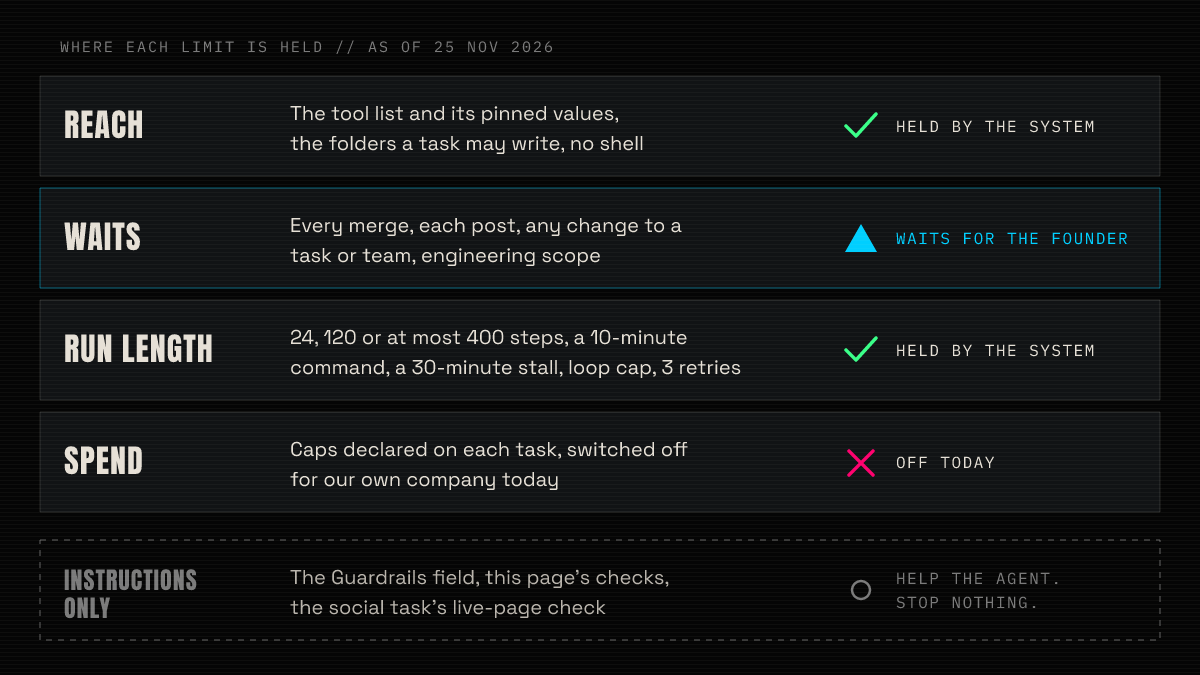
Three layers the system holds, one it doesn't hold for us today, and the rules that are only instructions.
What it can reach
OWASP's first fixes are about reach. "Limit the extensions that LLM agents are allowed to call to only the minimum necessary." And: "Avoid the use of open-ended extensions where possible (e.g., run a shell command, fetch a URL, etc.)."
In our OS, each task lists the tools it may call, and a run is offered those and no others. A call to any other tool ends the run. A tool can be pinned to some of its values: the task writing this page can open and update a pull request but has no way to merge one, it may write files only in the blog's own folders, and it can never push to our main branch. Its commands run without a shell: one of five named programs with its arguments, no pipes, and no git push (Workspaces).
The connection underneath keeps its own limits. "A read-only token cannot write, whatever the task lists," as our docs on gates and tool scopes put it. A task can also cap how many times one run makes a kind of call, and the call past the cap is never sent (Tasks).
What waits for a person
OWASP's fix for excessive autonomy is to "require a human to approve high-impact actions before they are taken." What the person sees matters as much as the stop. On our gates it is the exact call, stored before it runs: the merge, the post, the email with every recipient, its subject and its whole body. Approving runs exactly what was stored, and the system checks that what it sends is what was approved. A merge also waits until the run has written a summary of what it is asking, and a question comes with the task's recommended answer.
Which actions deserve a gate, and what each one costs in waiting, have their own pages: Human in the loop AI and AI agent management platform.
How long it runs, and how often it tries again
This is the layer most guardrail pages skip. OWASP files it under Unbounded Consumption, and its fixes are plain: "Set timeouts and throttle processing for resource-intensive operations," with "restrictions on the number of queued actions and total actions."
Here are ours. Every run has a step budget: 24 model turns by default, 120 for a task that works in a repository, and never more than 400. The task writing this page gets 400 steps and up to $6 a run on the top model tier. A command in a workspace is stopped at 10 minutes, and a run that records nothing for 30 minutes is stopped. A loop of tasks on one issue stops at its cap, four laps unless the task sets another, and a chain is retried automatically three times at most (Runs, Handoffs).
A step limit is blunt. A run that reaches it stops, even when most of its work is done. That is the point: an agent that is stuck stops using steps, and a person or a later run picks the work up.
What it spends
Spend is our gap, and we'd rather say so. Our spend limits are switched off for our own company, so no cap stops a run on cost. Even with limits on, the per-run cap is not enforced during a run on a Claude connection (Spend and models). So the $6 on the task writing this page is declared, not enforced. Each task's highest model tier still holds.
Our docs list what is planned: a run that reaches a cap stopping before its next paid model call, a per-run cap that holds on every connection, and a gate before a run spends more than an amount you set. None of those is live yet.
A limit that held this week
On 23 November our page on AI agent governance was merged, but it never went live, because the deploy failed. The task that shares a new page on social media checks the page first. It tried seven times, ten minutes apart, found the page not live each time, and its loop cap stopped it at seven. Nothing was drafted or posted, and it now waits for a person.
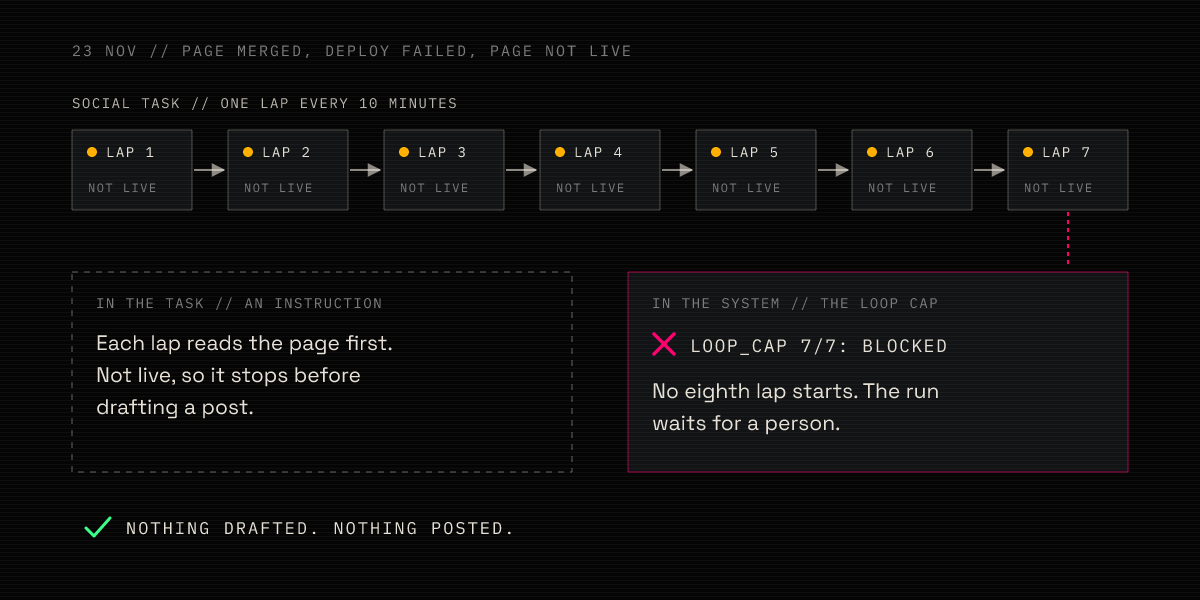
The task checked seven times. The cap stopped it there, and the work waits for a person.
Two kinds of limit worked together. The check for a live page is an instruction in the task. The cap is held by the system. Had the check been skipped, a post about a page nobody could open would still have stopped at our founder's gate before it went out. Had there been no cap, the task could have kept checking every ten minutes until someone noticed.
The same deploy also refused to apply a change to a secret setting on its own: it needs a person to read the plan first. Neither limit fixed the deploy. They made sure nothing went out on top of it, and that the problem waits for a person rather than for another lap.
Can an agent change its own limits?
Ask this of any tool you use. In ours, a person decides which tools a task may call. An agent can design a change to a task and ask for it, never make it. Spend caps are set by a person; no AI member can change one.
The counts work the same way. Only a person starts them again: a retry by a person resets them, a retry by a task does not. When one of our team leads' tasks tried to retry a chain that had used its three, the system refused.
Our self-improvement can reword a task's instructions after a run goes wrong, but an approved change "can never widen the task's tools, drop its gates or raise its spend" (Decision rights). And a task created with no gates gets one on every tool that reaches outside the company, unless a person removes it. The default is closed, and opening it is a person's decision.
What we record, and how we use it
OWASP is clear that logging prevents nothing. It "can limit the level of damage caused", because you can see what happened and respond. Every run of ours keeps its input, each step and tool call with what it sent and what came back, its cost, how it ended and any decision it waited on. How long that is kept depends on the plan (Isolation and retention).
When a run goes wrong, our self-improvement reads that record and decides what to change. On 28 October it read a run that had used every step on about twenty reads in a row and stopped before writing anything. Nothing was lost or changed, and the run had already been retried. It logged it as a first sighting to watch, and a second one would file an issue.
That is a step limit and a record working as a pair. The limit stopped the run. The record said why, so any fix goes to the cause rather than to a guess.
What a small company should set first
Here is what we'd tell a small company, in order. Start with what the agent can reach: give it only the tools its job needs, and connect each one with the least access that works. Put a gate on anything that leaves the company or can't be undone, more gates at the start, and remove them as the work earns trust. Give every task a step and retry limit, so a stuck agent stops instead of looping. Then check which of your limits are switched on today, not which ones exist.
And what to skip: writing long rule lists into the prompt and calling them guardrails. They help the agent, but they stop nothing.
Where to start
Take one agent that can act outside your company. Write down what it can reach, what waits for you, how long it may run and what it may spend. Then check, for each line, whether the system holds it or only the agent's instructions do. Gates and tool scopes and Runs show how we set ours. The free plan costs $0 a month.
Sources
- Our own records, as of 25 November 2026: run history, task records, the Blockers page, self-improvement decisions and decisions at gates, confirmed by our founder.
- Our own search research for this page: Google results and AI overview for "ai agent guardrails", US, 25 November 2026.
- IBM Think, Tom Krantz and Alexandra Jonker, "What are AI guardrails?", 17 September 2025, read 25 November 2026, for the definition and the highway picture.
- OWASP Gen AI Security Project, "LLM06:2025 Excessive Agency" and "LLM10:2025 Unbounded Consumption", OWASP Top 10 for LLM Applications 2025, read 25 November 2026, for the risks and fixes quoted.
- LangChain, "Guardrails", LangChain docs, read 25 November 2026, for what a framework offers.
- Zero Human docs: Tasks, Gates and tool scopes, Workspaces, Runs, Handoffs, Spend and models, Decision rights and Isolation and retention, read 25 November 2026.
- Zero Human pricing, read 25 November 2026.