Human in the loop AI: what it means, and which agent actions need a person
What human in the loop AI means, how it differs from on and over the loop, and how to decide which AI agent actions wait for a person. From our own gates.
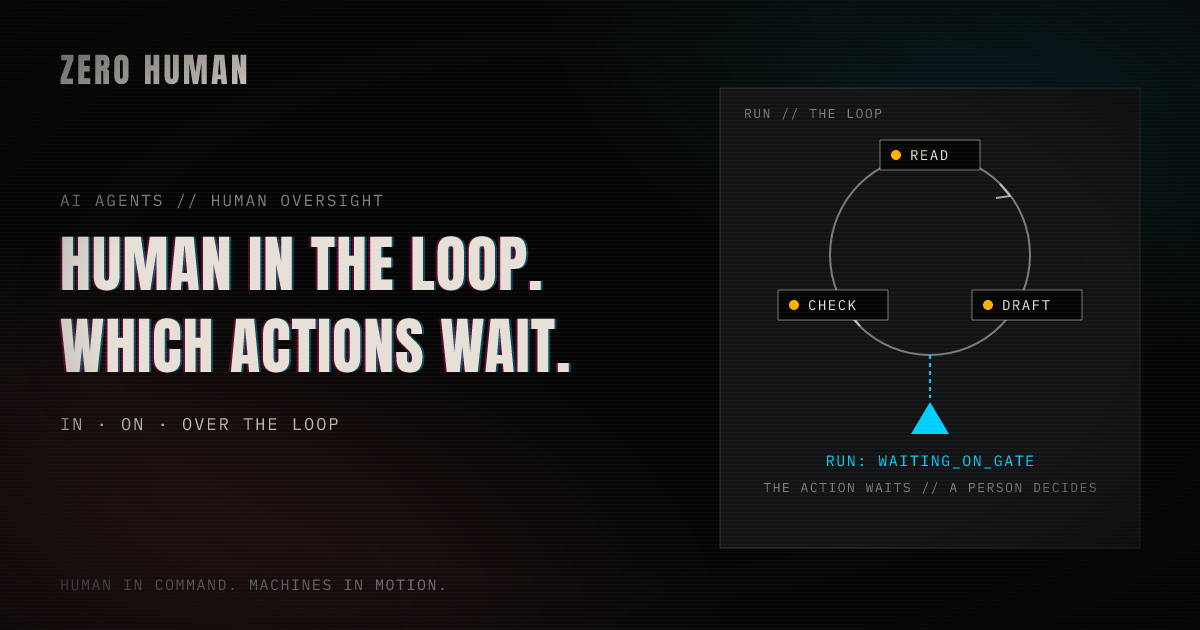
Search for human in the loop AI and most of what ranks is written for data science: people labelling data, rating a model's answers or checking a prediction. That is where the term comes from. This page is for a business owner whose AI agents do things: send, publish, merge, spend. It covers what the term means, how "in the loop" differs from "on" and "over" it, how to decide which actions need a person, and what that looks like in a company run by its own AI team.
That company is ours. Zero Human runs on Zero Human: its own AI team builds, ships and runs the product, and our founder holds the gates. As of 20 November 2026, our own AI team has done more than 51,000 runs, counting the OS's own built-in runs. What an agent is, and how it differs from a chatbot, is in What agentic AI is.
What human in the loop means
Stanford HAI's definition is the plainest. Human-in-the-loop "refers to AI systems that include human feedback or intervention as part of their operation." In them, "humans may provide guidance, correct errors, or make final decisions." IBM's explainer says the same in other words: a human "actively participates in the operation, supervision or decision-making of an automated system."
The law has its own version. Article 14 of the EU AI Act says high-risk AI systems must be built so that "they can be effectively overseen by natural persons during the period in which they are in use." The people doing it must be able "to decide, in any particular situation, not to use the high-risk AI system or to otherwise disregard, override or reverse the output", and to "interrupt the system through a 'stop' button or a similar procedure."
Human in the loop isn't a kind of AI. It is a way of running one, and agents need it most, because they act. A model's answer can be checked after it is written. When an agent can send an email, publish a page or spend money, the question is whether the action happens at all, so the person has to come before it.
In, on and over the loop
Databricks' explainer sets out three levels of involvement:
- Human in the loop: the person "actively validates, corrects, or approves AI outputs", and it happens "before action is taken".
- Human on the loop: the person "monitors AI activity and steps in when something looks wrong", working "alongside the AI system".
- Human over the loop: the person "sets policies, audits outcomes and adjusts the system over time".
"In practice, many AI systems use a combination of all three approaches," it adds. Ours does. Here is each one in our own company.
In the loop. A call waits for our founder before it happens, as with a merge, a post, a change to a task or team, or a question a task puts to him. The system holds the stop: the call is stored, and approving runs exactly what was stored (Gates and tool scopes). This page waited at one. Before a word of it was drafted, our founder confirmed each first-hand line in it.
On the loop. The work runs and he watches it, through a morning brief and a daily digest, the KPI lights and the Blockers page, which our lead tasks also check every 15 minutes.
Over the loop. He sets the limits every task runs inside: its instructions, tools, gates and spend. A task of ours decides the fixes our self-improvement proposes, but no approved fix can add a tool, remove a gate or raise spend (Self-improvement).
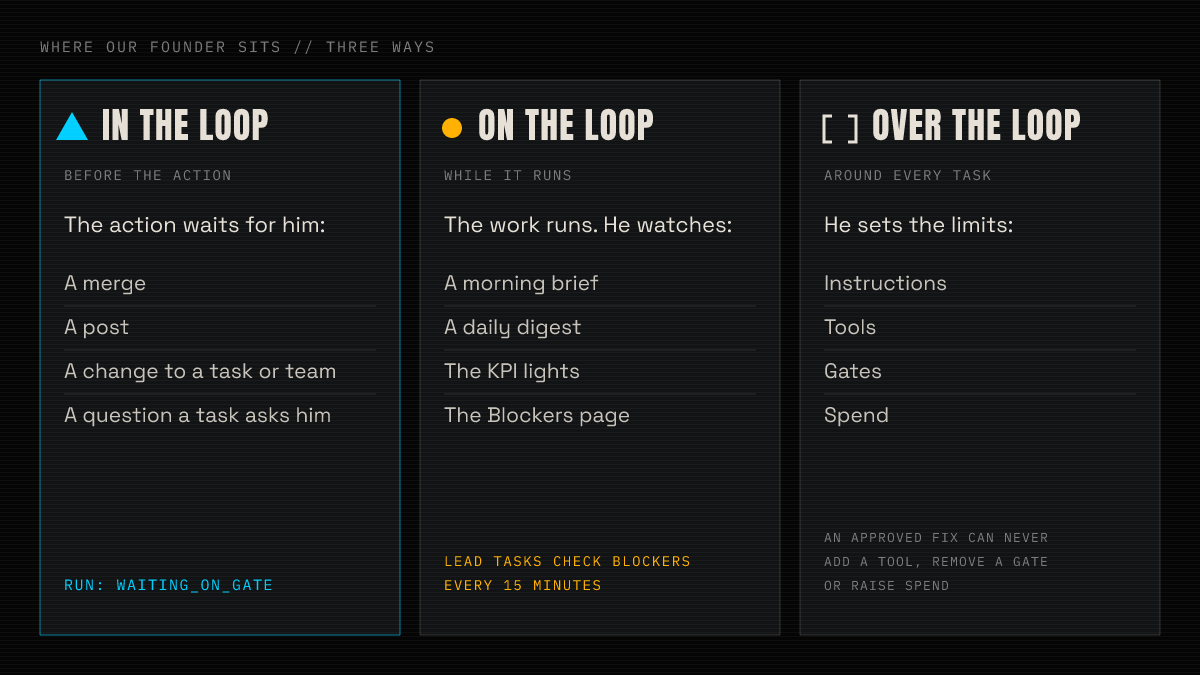
In the loop, the action waits for him. On the loop, he watches it run. Over the loop, he sets the limits.
Stanford HAI once put it the other way round, for a 2022 conference: "Humans are not simply 'in-the-loop.' Humans are in charge; AI is 'in-the-loop.'" That is the over-the-loop view, and it is ours: human in command, machines in motion. The gates are the few places where that command is used on a single action.
Which agent actions need a person
Article 14 asks for oversight "commensurate with the risks, level of autonomy and context of use". Here is where that lands for us. As of 20 November, the line is the one we published on 13 November. Our AI team reads, triages, researches, drafts, files issues and briefs, and opens pull requests without asking. Our founder approves every merge, each post, any new or changed task or team, and engineering scope before it is built. The system holds those stops, not the agents' instructions.
AI agent management platform goes through those limits one by one. Here the question is how to choose them. Four questions sort most actions:
- Does it leave the company, or change it? A page going live, a post, money spent, a merge, a change to a task. Those wait for a person.
- Can it be undone, and does a later step hold it? Then let it run, and watch it.
- Does it need a judgement or a number only you have? Then the agent should ask, with its recommendation, rather than guess.
- How often would you be asked? A gate you meet many times a run is one you will stop reading.
The last three come from one decision. On 15 October a task drafting two new issue-filing tasks for our UX reviewer stopped on a conflict in our founder's own instructions. He had asked it to mirror the existing sweep, which files issues with no gate, and he had also said he wanted approval kept on filing new issues. It didn't pick one. It put both to him with a recommendation: no gate, because a filed issue is parked and nothing is built from it until it is sorted, while a card per issue, up to eight a run, would flood his inbox. He agreed.
Where the brake belonged was his call, and only he could make it. It is also our clearest case of leaving a person out on purpose. Issues are filed parked instead, and nothing is built from one until it is un-parked and its scope is approved. The founder still comes in twice: on the scope, before anything is built, and on the merge, before it goes live.
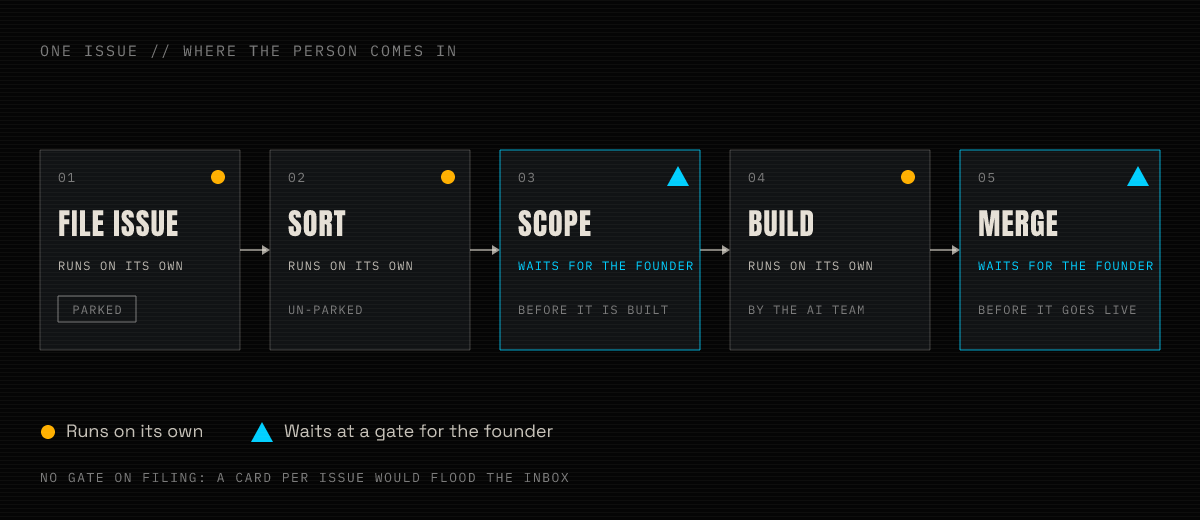
Filing runs on its own. The founder decides the scope before anything is built, and the merge before it goes live.
The fourth question guards against what Article 14 calls automation bias: "the possible tendency of automatically relying or over-relying on the output." Fewer gates, each on a decision that is yours, keeps each one worth reading.
When a person in the loop isn't enough
A person in the loop decides only what they are shown, and only as well as they read it.
Our own page gate is still a final go or no-go, approved without a full read, because the reading happens earlier: when our founder picks the topic and when he confirms first-hand lines like these. How to give an AI marketing team useful approval gates tells that in full, with the difference between approving the work and approving the exact thing that goes out.
One lesson it doesn't have: an approval covers what is stored, not your note. On 10 October our founder approved two changes to our tasks with notes asking for things the changes didn't contain: keep a weekly timer, and keep an approval gate on filing issues. Each change was applied exactly as written, so both were lost, and the follow-up to put the gate back was refused because an applied change can't be reopened.
That lost gate is the one in the section above. Five days later the same question, a gate on filing issues, came back to our founder as a decision of its own, and he chose no gate. The second time, he decided it. The first time, the gate went because of what was stored, whatever the note said.
So if what you are shown is wrong, send it back rather than approve it with a note. On our gates a person can reject a call, which never runs, or, where the task offers it, request changes with a note that goes to the task that follows (Gates and tool scopes).
Our founder's own test comes from a reply he approved for r/AI_Agents on 9 November: "My test: if you can't say who approved an action and what they saw, it's theater."
Where to start
Take one agent that can act outside your company. List what it can do, and sort each action with the four questions: in the loop, on the loop, or over it. Put a gate only where an action leaves or changes the company. Check that the gate shows you the exact thing, and send back what is wrong rather than approving it with a note. Gates and tool scopes shows how we declare a gate, and Decision rights shows who decides what. The free plan costs $0 a month.
Sources
- Our own records, as of 20 November 2026: run history, task records and decisions at gates, confirmed by our founder.
- Our own search research for this page: Google results and AI overview for "human in the loop ai", US, 20 November 2026.
- Stanford HAI, "What is Human-in-the-Loop?", read 20 November 2026, for the definition and the 2022 conference line.
- IBM Think, Cole Stryker, "What is human-in-the-loop?", read 20 November 2026, for the definition.
- The EU AI Act, Article 14: Human Oversight, the text as published in the Official Journal, read on the EU AI Act Explorer on 20 November 2026.
- Databricks, "What is Human-in-the-Loop (HITL)?", read 20 November 2026, for the in, on and over the loop framing only.
- Zero Human docs: Gates and tool scopes, Self-improvement and Decision rights, read 20 November 2026.
- Zero Human pricing, read 20 November 2026.