AI agent governance: five rules a small company writes down, and how we hold ours
What AI agent governance means, what a working setup contains, and how a small company starts without an IT or compliance team: five written rules, shown from a company that runs on its own AI team.
Search for AI agent governance and almost everything that ranks is written for an enterprise IT, security or compliance team, and much of it sells a platform. This page is for a business owner who has none of those teams. It covers what agent governance means, what a working setup contains, and how a small company starts: write five rules down, and check that something other than the agent holds each one.
It is written from our own setup. Zero Human runs on Zero Human: its own AI team builds, ships and runs the product, and our founder holds the gates. As of 23 November 2026, our own AI team has done more than 54,000 runs, counting the OS's own built-in runs.
What AI agent governance is
A 2025 field guide to AI agent governance, by Jam Kraprayoon, Zoe Williams and Rida Fayyaz, describes agents as AI systems that can "autonomously achieve goals in the world, with little to no explicit human instruction about how to do so." It also says the field is new: its questions and their "associated interventions remain in their infancy."
Noam Kolt's paper Governing AI Agents gives the plainest way in. It reads an AI agent through agency law, the rules for anyone who acts on someone else's behalf, and names the problems that come with it: "information asymmetry, discretionary authority, and loyalty." The agent knows more about what it did than you do. It acts on judgement you handed it. And it has to act for you, not around you. Kolt adds that the usual fixes, "incentive design, monitoring, and enforcement", "might not be effective" for agents "that make uninterpretable decisions and operate at unprecedented speed and scale."
The US standards body NIST publishes an AI Risk Management Framework, "intended for voluntary use". Of its four functions, it treats govern as "a cross-cutting function" that runs through the other three. Its govern outcomes include an inventory of the AI systems you run, roles and responsibilities that are "documented and are clear", and executive leadership that "takes responsibility for decisions about risks".
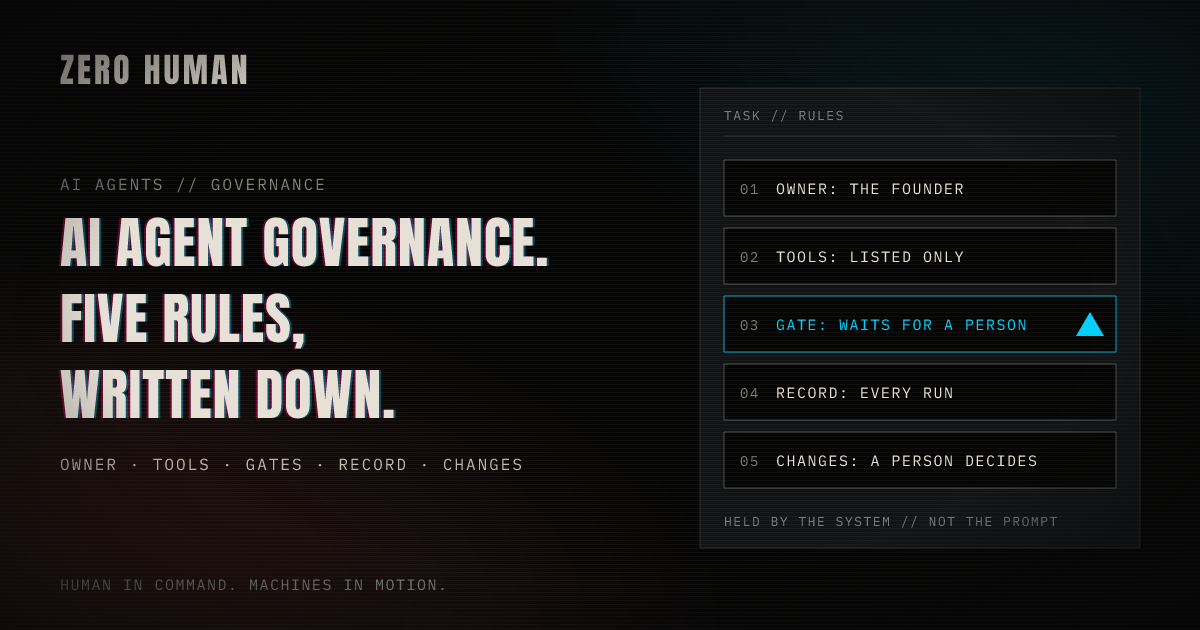
For a small company, then, AI agent governance is a short set of written rules: who owns each agent, what it may touch, what waits for a person, what is recorded, and who can change the rules. Generic answers start with ethics and compliance policy. This starts with what an agent may do, and who answers for it.
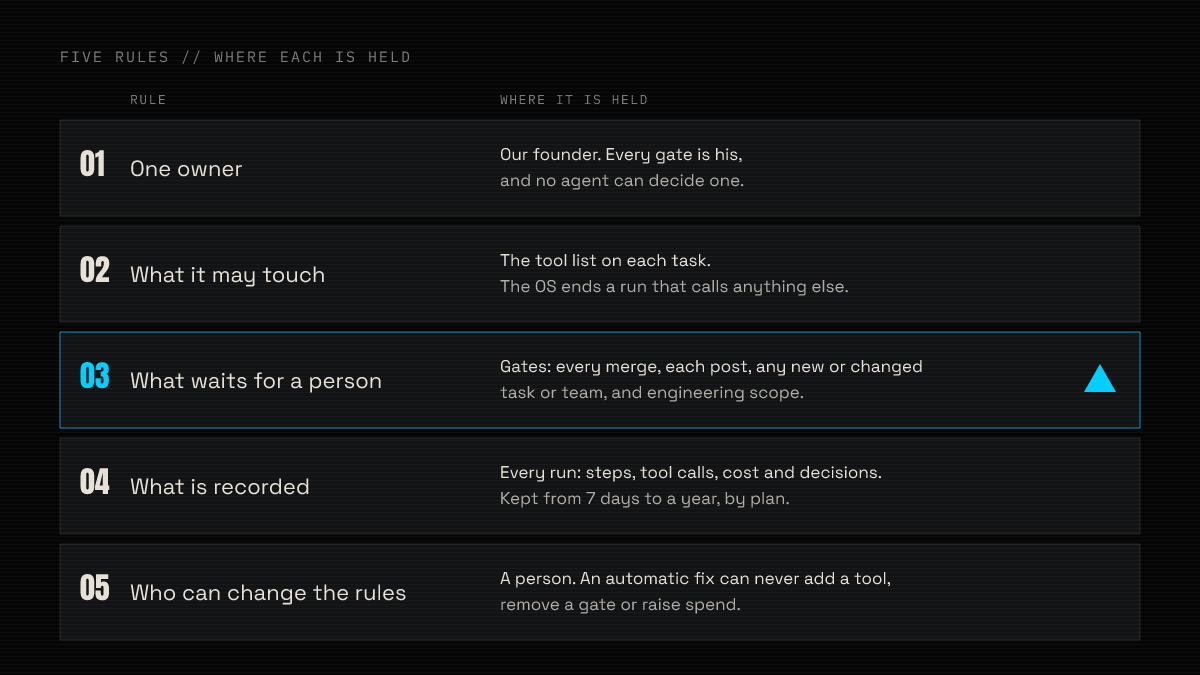
Five rules, and where each one is held. None of them lives only in the agent's instructions.
Rule 1: one person owns each agent
Every other rule needs someone to hold it, so ownership comes first.
In our company that person is our founder. He is the owner, every gate is his, and no agent can decide one. Each team's KPIs belong to its lead, an AI member, but a lead can't approve a gate or change its own limits. Every decision card names the person who asked for the work, or says nobody did, as for a scheduled run. Two pages of our docs set this down: Decision rights and Gates and tool scopes.
Whoever it is in your company, write the name down before the agent runs. An agent nobody owns is an agent nobody is watching.
Rule 2: list what it may touch, and let the system hold the list
The second rule is a list: what each agent may read, and what it may change. It only works if something outside the agent enforces it.
In our OS, each task lists the tools its runs may call, and a run is offered those and no others. The connection underneath keeps its own limits as well. A read-only connection can't write, whatever the task lists, so connect each tool with the least access the work needs (Gates and tool scopes).
Here is the list holding. On 22 November our self-improvement triage looked at a run of one of our alert tasks, a task that only reads. The run had tried to call a tool that wasn't on its list, a tool for reading chats. The call never went through: the OS ended the run instead. Nothing was lost or sent, and a retry succeeded. The triage logged it as a first sighting to watch. It files an issue only if the same thing happens again.
That is Kolt's discretionary authority in miniature: the agent reached for something it wasn't given. A list kept only in the agent's instructions would not have stopped it.
Rule 3: say what waits for a person
The third rule names the actions an agent may not take alone. Ours, as of 23 November, is the line we published on 13 and 20 November. Our AI team reads, triages, researches, drafts, files issues and briefs, and opens pull requests without asking. Our founder approves every merge, each post, any new or changed task or team, and engineering scope before it is built. The system holds those stops, not the agents' instructions.
Choosing where your own stops go is a page of its own: Human in the loop AI has four questions that sort most actions, and AI agent management platform shows what each stop costs in waiting. For governance, the point is simpler. Write the line down, so the agent, the owner and anyone checking later all read the same one.
Rule 4: decide what is recorded, and for how long
NIST's framework notes that documentation "can enhance transparency, improve human review processes, and bolster accountability." For an agent, that documentation is the record of what it did.
Every run of ours keeps its input, each step and tool call, its cost, how it ended and any decision it waited on. How long that lasts depends on the plan. Run history is deleted 7 days after the work finishes on Free and Starter, 30 days on Company and Scale, and a year on Enterprise. Memory stays until someone removes it, and a removed note is hidden from every run but kept on record for audit. A decided gate can't be decided again (Isolation and retention).
The second half of this rule is the one people skip. A record deleted after a week can't answer a question asked a month later. Decide how far back you will need to look, and check that your tools keep the record that long.
Rule 5: decide who can change the rules
The last rule covers the other four. Without it, the first four last only until someone, or something, edits them.
Every agent of ours works inside four limits people set: its instructions, its tools, its gates and its spend. AI employees explains each one. Instructions are the limit that changes most, and most changes now come through our self-improvement. On 22 November it changed the instructions of the task that picks up engineering issues. An issue that already has a work item no longer uses up one of the task's three tries. The change came from a run that went wrong and went through our triage. Like every self-improvement change, it could only change the wording. It could not add a tool, remove a gate or raise spend (Self-improvement).
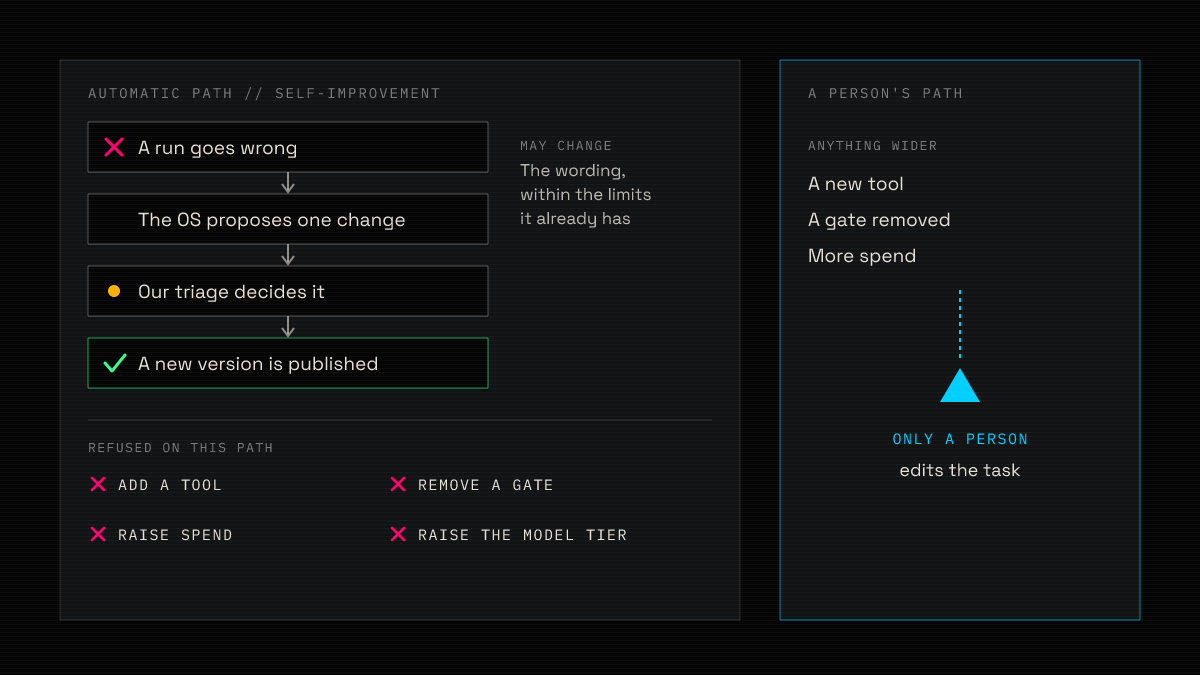
An automatic fix can narrow or reword a task's rules. Only a person can widen them.
A rule can also be too tight for a moment, and the fix isn't always to change it. On 14 November, four engineering pull requests had each used up their three automatic retries while our main branch was broken. Our founder approved one more try of each, started by a person, with conditions. No more than two could run at once, and only after the main-branch repair was merged and its check had passed. His approval also said what it did not cover: no shipping and no outgoing messages. The retry limit itself stayed as it was.
That is what a written exception looks like: who allowed it, how far it goes, and what it leaves out. The rule stays in place for the next time.
Where the five rules sit in a framework
You don't need a certified framework to start, and NIST doesn't ask for one. It says organisations may apply its functions "based on their resources and capabilities", and some "may choose to select from among the categories and subcategories". If you later want to show your rules against it, here is where each one sits.
| Rule | Where it sits in the NIST AI RMF |
|---|---|
| One owner per agent | Govern 1.6, an inventory of AI systems; Govern 2.3, executive leadership "takes responsibility for decisions about risks" |
| What it may touch | Map 3.3, "targeted application scope is specified and documented" |
| What waits for a person | Govern 3.2, roles and responsibilities "for human-AI configurations and oversight of AI systems" |
| What is recorded | Measure 2.4, the system's "functionality and behavior" are "monitored when in production" |
| Who can change the rules | Govern 1.5, "periodic review of the risk management process", with roles "clearly defined"; Manage 4.1, plans that include "change management" |
How a five-person company starts
Before your first agent runs, write five lines on one page. First, the one person who decides for it. Second, what it can read and what it can change. Third, the actions that wait for that person: anything that leaves the company or can't be undone, like paying, sending or deleting. Fourth, what is recorded, and for how long. Fifth, who may change these lines: a person, never the agent. Then check that the system holds each line, not only the agent's instructions. Size what an agent may do by the damage it could do, not by how sure it sounds.
The setup itself, from the model key to the first task, is in AI agents for small business. Decision rights and Gates and tool scopes show how we write our own lines down. The free plan costs $0 a month.
Sources
- Our own records, as of 23 November 2026: run history, task records, self-improvement decisions and decisions at gates, confirmed by our founder.
- Our own search research for this page: Google results and AI overview, and a ChatGPT answer with web search, for "ai agent governance", US, 23 November 2026.
- Jam Kraprayoon, Zoe Williams and Rida Fayyaz, "AI Agent Governance: A Field Guide", arXiv 2505.21808, 27 May 2025, read 23 November 2026, for the description of an agent and the state of the field.
- Noam Kolt, "Governing AI Agents", arXiv 2501.07913, revised 11 February 2025, forthcoming in the Notre Dame Law Review, read 23 November 2026, for the agency problems and the limits of the usual fixes.
- NIST, AI Risk Management Framework and its AI RMF Core (AI RMF 1.0, 2023), read 23 November 2026, for the govern function and each outcome quoted.
- Zero Human docs: Decision rights, Gates and tool scopes, Isolation and retention and Self-improvement, read 23 November 2026.
- Zero Human pricing, read 23 November 2026.